Data Review and Faculty Summary
Methods
A literature search was conducted on April 19, 2014, to identify studies that evaluated steroid-sparing and integrin antagonists in CD. We conducted an online search of publications listed in the MEDLINE database (PubMed, 1997 to 2014, US National Library of Medicine [NLM], National Center for Biotechnology Information [NCBI]). Studies were identified using the search term “natalizumab” (1285 articles). with (AND) English (1016 articles) AND “Crohn’s disease” (154 articles). The search term “vedolizumab” identified 52 articles and combined with (AND) “Crohn’s disease” produced 27 articles. A total of 5 articles were eventually chosen as relevant to the statement. The types of studies included cohort studies and randomized controlled trials.
Evidence
The steroid-sparing effects of integrin antagonists in patients with CD were first reported by Sandborn and colleagues,5 whose data supported the efficacy of natalizumab, a humanized IgG4 monoclonal antibody to the α4 integrin that blocks both α4β1 and α4β7 integrins. Patients with moderately to severely active CD (N=905) were randomized (4:1) to receive induction therapy with natalizumab or placebo for 12 weeks. Patients who were receiving steroids at study baseline held the dose steady for 10 weeks and then began tapering. At week 12,339 patients who had responded to induction therapy with natalizumab were re-randomized (1:1) to receive maintenance therapy with natalizumab or placebo for an additional 44 weeks. Among the 143 patients who were receiving steroids at the beginning of the maintenance trial, natalizumab was significantly more effective than placebo for steroid sparing and maintenance of steroid-free remission. The steroid-free remission rates at week 60 were 15% for placebo and 42% for natalizumab (P≤0.001).5
Kane and colleagues6 reported on 30 patients with moderately to severely active CD, treated with natalizumab, of whom 7 (23%) were receiving steroids. Overall, 26 patients responded to natalizumab. Four of 7 patients who received steroids discontinued steroid treatment; the other 3 patients required short courses (<1 month).
Sakuraba and colleagues7 reported on 49 patients with moderately to severely active CD treated with natalizumab at the University of Chicago, of whom 25 (51%) were receiving steroids at baseline. A steroid-sparing effect was observed in some patients. However, the benefits of steroid-sparing have been largely outweighed by the risk of progressive multifocal leukoencephalopathy (PML) associated with natalizumab, and its use in the treatment of CD has been limited.8
Vedolizumab, a humanized, gut-selective IgG1 monoclonal antibody to α4β7 integrin, has also been reported to have steroid-sparing effects. Parikh and colleagues9 reported on a Phase 2 study of vedolizumab in 72 patients with moderately to severely active CD (n=19) or ulcerative colitis (UC) (n=53). Of the 19 patients who were receiving steroids at baseline (IBD type not differentiated), 15 (79%) were able to substantially reduce or discontinue steroid use. These findings were later confirmed by Sandborn and colleagues4 who also reported that vedolizumab was effective for steroid sparing.4 In this Phase 3 study, 368 patients with moderately to severely active CD were randomized (3:2) to receive induction therapy with vedolizumab or placebo for 6 weeks. In addition, another 747 patients received open-label vedolizumab induction for 6 weeks. The 461 patients who had responded to induction therapy with vedolizumab were re-randomized at week 6 (2:1) to receive maintenance therapy with vedolizumab or placebo for 46 weeks. Patients who were receiving steroids at study baseline then began tapering. Among the 244 patients who were receiving steroids at the beginning of the maintenance trial, vedolizumab was significantly more effective than placebo for steroid-sparing and maintenance of steroid-free remission. The steroid-free remission rates at week 52 were 15.9% for placebo, 31.7% for vedolizumab 300 mg every 8 weeks (P=0.02), and 28.8% for vedolizumab every 4 weeks (P=0.04).4 Unlike natalizumab, the gut-selectivity of vedolizumab suggests that adverse events associated with systemically acting therapies would be minimal. There have been no reports of PML with vedolizumab.10
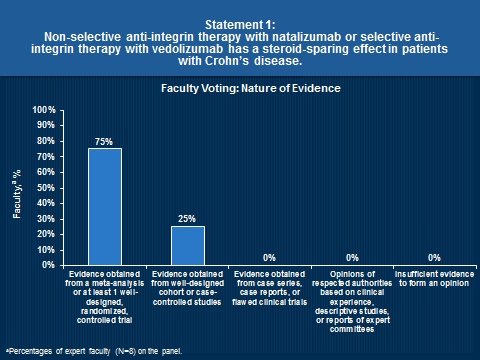
Nature of Evidence Results