Data Review and Faculty Summary
Methods
A literature search was conducted on April 2, 2014, to identify studies that evaluated the influence of postoperative use of anti-tumor necrosis factor-α (anti-TNF) drugs on postoperative complications of Crohn’s disease (CD). An online search was executed of publications listed in the MEDLINE database (PubMed, US National Library of Medicine [NLM], National Center for Biotechnology Information [NCBI]). Studies were identified by combining the medical subject headings (MeSH): “Crohn’s Disease,” “Surgical Procedures, Operative,” and “Recurrence,” which identified 793 articles. These were then limited to “Species: Humans” (788 articles), “Languages: English” (616 articles), Publication dates From 1980/01/01 to 2016/06/03 (567 articles), and “Randomized controlled trial” (31 articles). The limited articles were subsequently combined (AND) with the individual text words and terms: “post-operative recurrence” (299 articles), “smoking” (39 articles), “metronidazole” (17 articles), “mesalazine OR mesalamine OR 5 ASA” (37 articles), “azathioprine OR mercaptopurine” (50 articles), “adalimumab” (11 articles), and “infliximab” (38 articles). Finally 15 articles were identified as relevant to the statement.
Evidence
During the 1990s, a placebo-controlled, randomized European cooperative study showed that mesalamine (4 g/day) for 18 months did not significantly affect overall clinical recurrence.7 However a retrospective subgroup analysis showed a significantly reduced clinical relapse rate of 21.8% with mesalamine (4 g/day) compared with 39.7% with placebo (P=0.02) in a subgroup of 124 patients who had CD isolated to the small intestine.7 A Cochrane Database systematic review in 2009 indicated that mesalamine reduced clinical recurrence by about one quarter (relative risk [RR], 0.76; 95% confidence interval [CI], 0.62–0.94; number needed to treat [NNT], 12) and the risk of severe (Rutgeerts score ≥i3) endoscopic recurrence by half (RR, 0.50; 95% CI, 0.29–0.84; NNT, 8) compared with placebo.4 Meta-analyses have been mostly consistent in their findings,1 although one review that evaluated surgical techniques and postoperative medications found that mesalamine prevented clinical recurrence only.8 In that analysis, thiopurines and nitroimidazole antibiotics reduced both clinical and endoscopic recurrence of CD, and IFX prevented endoscopic recurrence only.
Nitroimidazole antibiotic use (metronidazole [MZ] 20 mg/kg body weight/day for 3 months; MZ: n=30; placebo: n=30) after surgery significantly reduced the incidence of endoscopic recurrence (P=0.09) or severe (Rutgeerts score ≥i3) endoscopic recurrence (P=0.02) compared with placebo.9 Similarly, use of the nitroimidazole antibiotic ornidazole (ONZ; 1 g/day for 12 months; ONZ n=38; placebo n=40)10 after surgery significantly reduced clinical recurrence at 1-year of follow-up compared with placebo (P=0.0046); however the effect was not sustained beyond 1 year for clinical recurrence (P=0.17 at 2 years; P=0.53 at 3 years).10 The Cochrane review concluded that the risk of severe (Rutgeerts score ≥i2) endoscopic recurrence at 3 months after nitroimidazole antibiotic treatment was halved (RR, 0.44; 95% CI, 0.26–0.74; NNT, 4), which is comparable to mesalamine.4 However, the different definitions of severe relapse with nitroimidazole antibiotics (Rutgeerts score ≥i2) compared with mesalamine (Rutgeerts score ≥i3) in the Cochrane review is notable. In addition, twice as many patients receiving nitroimidazole antibiotics had adverse events (RR, 2.39; 95% CI, 1.5–3.7) compared with placebo.4
Thiopurines (azathioprine [AZA] or 6-mercaptopurine [MP]) have been compared with mesalamine as an adjunct to metronidazole in randomized controlled trials. In a study conducted in the United States that compared MP (50 mg) or mesalamine (3 g) with placebo, observed rates of endoscopic recurrence at 2 years were 43% (95% CI, 28–63), 63% (95%CI, 47–79), and 64% (95% CI, 46–81), respectively.11 That only 57 of 131 patients completed the study, the low dose of MP, and an endoscopic recurrence rate lower than clinical recurrence11 may have influenced the study findings. An Italian study in 142 patients randomized to receive AZA (2 mg/kg/day) or mesalamine (3 g/day) for 24 months showed comparable rates of clinical relapse (intention-to-treat [ITT] odds ratio [OR], 2.04; 95% CI, 0.89–4.67). No difference was detected in surgical relapse rates between the two groups. However, a favorable effect of AZA was observed for patients with previous intestinal resection (OR, 4.83; 95% CI, 1.47–15.8).12 Another study (AZT-2) has since compared AZA (2–2.5 mg/kg/day) versus mesalamine (4 g/day) in a cohort of 78 patients with endoscopic evidence of a high risk of recurrence.13 Clinical recurrence within 1 year was lower in the AZA group (0 of 41 vs 4 of 37, P=0.031), but 9 of 41 (22%) discontinued AZA because of an adverse drug reaction, compared with 0 of 37 on mesalamine (P=0.002). The addition of metronidazole (15–20 mg/kg/day) for 3 months after surgery to treatment with AZA (2–2.5 mg/kg/day) for 1 year in a placebo-controlled Spanish study of just 50 patients showed no additional benefit compared with AZA monotherapy in reducing endoscopic recurrence (36% vs 56%; P=0.15) at 12 months.14 The conclusion in the Cochrane review4 was that AZA/MP was more effective than either placebo (clinical recurrence: RR, 0.59; 95% CI, 0.38–0.92; NNT, 7, and severe endoscopic recurrence: RR, 0.64; 95% CI, 0.44–0.92; NNT, 4) or mesalamine, but mesalamine was associated with fewer serious adverse events (RR, 0.51; 95% CI, 0.30–0.89).
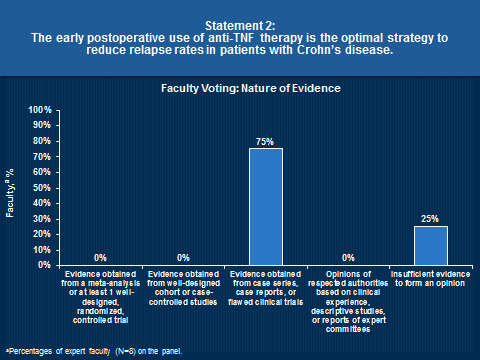
The potential benefit of anti-TNF agents for early postoperative therapy surfaced in a proof-of-concept, randomized controlled trial of 24 patients.5 The study reported that IFX induction within 4 weeks of an ileocolic anastomosis and subsequent IFX maintenance therapy achieved endoscopic remission (Rutgeerts score i0 or i1) in 90.9% of patients at 12 months, compared with 15.4% of those who received placebo (P=0.0006). Clinical recurrence (CD Activity Index [CDAI] >200) was also reduced (0 of 11 patients vs 5 of 13 patients, respectively, P=0.046). On the other hand, another randomized, proof-of-concept, open-label study of IFX monotherapy, without thiopurines or prednisolone, showed no significant difference in clinical remission, judged by CDAI ≤150 at 12 months (remission: 13 of 15 [87%] patients in the IFX treatment group vs 12 of 16 [75%] in the control group) or at 36 months (12 of 15 [80%] vs 12 of 16 [75%], respectively).15 All patients in this study received mesalamine (1500 mg/day). Although not presented at the live meeting of the authors, a 5-year follow-up of the 24 patients in the US study by Regueiro et al.5 found that patients originally assigned to IFX experienced a longer mean time to surgery (1798 ± 359 days) than patients originally assigned to the placebo group (1058 ± 529 days; P=0.04).16 Surgical recurrence, defined by the need for additional surgical resection, was significantly reduced among patients who received IFX for at least 60% of the follow-up period compared with patients who received IFX less frequently (20.0% vs 64.3%, respectively; P=0.047).16 The multicenter, randomized, controlled PREVENT trial (ClinicalTrials.gov ID: NCT01190839)6 that compared IFX with placebo infusions in 297 patients over 4 years (200 weeks) after ileocolic resection was terminated early (August 2014) because it did not meet its primary endpoint of reduced clinical recurrence. The PREVENT study was assessed after the live appraisal, therefore the results were not presented or voted on by the faculty.
For adalimumab (ADA), another randomized controlled trial compared ADA (subcutaneous injections of 160 mg at 0 weeks, 80 mg at 2 weeks, and 40 mg every 2 weeks thereafter; n=16) with AZA (2 mg/kg/day; n=17) or mesalamine (3 g/day divided into 3 doses; n=18), all started within 4 weeks of ileocolic resection.18 Endoscopic recurrence (Rutgeerts score ≥i2) at 2 years was lowest in the ADA group (1 of 16 [6%] patients) versus 11 of 17 (65%) patients on AZA and 15 of 18 (83%) patients on mesalamine. Differences in endoscopic recurrence rates significantly favored ADA compared with either AZA or mesalamine, and clinical recurrence according to a novel grading scale was lowest in the ADA group (2 of 16 patients vs 11 of 17 patients on AZA; OR, 0.078; 95% CI, 0.01–0.46 and 9 of 18 patients on mesalamine; OR, 0.143; 95% CI, 0.03–0.82).18 Another open-label study allocated 8 patients to early ADA (14 days postoperative) and 15 to delayed ADA (after 6 months, with endoscopic recurrence).19 Early treatment was associated with endoscopic recurrence in 2 of 8 patients within 24 months; delayed treatment improved endoscopic findings in 9 of 15 patients (Rutgeerts score i0; n=3 or Rutgeerts score i1; n=6) within 24 months. The Post-Operative Crohn’s Endoscopic Recurrence (POCER) study20 was designed to compare active care (colonoscopy at 6 months and step-up treatment) and therapeutic management with standard care (not involving colonoscopic assessment 6 months after surgery), rather than the efficacy of ADA alone, which was only one component of the active strategy. Active treatment was demonstrated to be better than standard treatment in preventing CD recurrence.21 The POCER study was assessed after the live appraisal; therefore, the results were not presented or voted on by the faculty.
Nature of Evidence Results