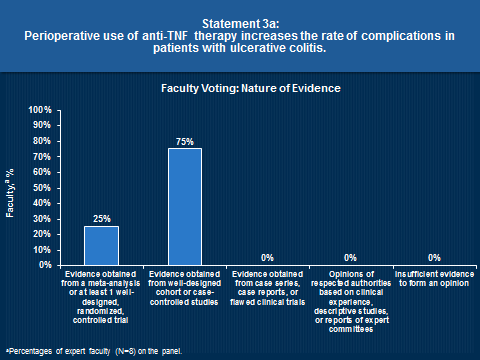
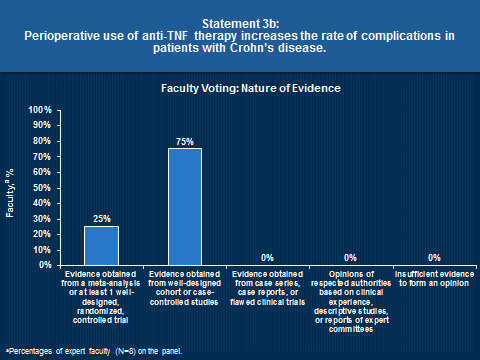
Data Review and Faculty Summary
Methods
A literature search was conducted on April 22, 2014, to identify studies that evaluated the impact of perioperative use of anti-TNF drugs on the rate of postoperative complications of IBD, UC, and CD. We conducted an online search of publications listed in the MEDLINE database (PubMed 1997 to April 2014). Studies were identified combining the search terms “antibodies,” “monoclonal,” and “inflammatory bowel diseases” as medical subject headings (MeSH). A total of 3366 articles were identified. The separate MeSH headings “surgical procedures, operative” (425 articles), “perioperative period” (15 articles), and “postoperative complications” (71 articles) were added. The original 3366 articles were also combined with the separate words: “surgery” (720 articles), “perioperative” (12 articles), “preoperative” (37 articles), and “postoperative” (104 articles). Ultimately, 13 articles were identified as relevant to the statement. The types of studies included were meta-analyses, cohort studies from referral centers, and population-based studies.
Evidence
In 2012, a meta-analysis of the available studies in CD found a significantly increased risk of infectious complications (odds ratio [OR], 1.50; 95% confidence interval [CI], 1.08–2.08) and a non-significant trend toward increased rates of noninfectious complications (OR, 2.00; 95% CI, 0.89–4.46) and overall complications (OR, 1.72; 95% CI, 0.93–3.19) in CD patients undergoing abdominal surgery with recent exposure to anti-TNF treatment.5 The same year, Yang et al6 published a meta-analysis of 13 available studies involving 2933 UC patients undergoing abdominal surgery that did not find a significant association between infliximab (IFX) therapy preoperatively and infectious or noninfectious postoperative complications. In 2013, a meta-analysis by Billioud et al7 showed that preoperative anti-TNF treatment increased the rate of overall short-term postoperative complications in IBD patients (OR, 1.28; 95% CI, 1.04–1.57) and infectious complications in CD patients (OR, 1.45; 95% CI, 1.03–2.05). Postoperative complications were not increased by preoperative anti-TNF treatment in UC patients.7 In the meta-analysis, by Narula et al,1 preoperative anti-TNF therapy in IBD patients significantly increased the rates of postoperative infectious (OR, 1.56; 95% CI, 1.09–2.24), noninfectious (OR, 1.57; 95% CI, 1.14–2.17), and total (OR, 1.73; 95% CI, 1.23–2.43) complications. When studies were limited to CD patients, a statistically significant increase in the rates of infectious (OR, 1.93; 95% CI, 1.28–2.89) and total (OR, 2.19; 95% CI, 1.69–2.84) complications, and a trend towards increased occurrence of noninfectious complications (OR, 1.73; 95% CI, 0.94–3.17) were revealed. Studies limited to patients with UC did not identify significant increases in the rates of infectious (OR, 1.39; 95% CI, 0.56–3.45), noninfectious (OR, 1.40; 95% CI, 0.68–2.85), or total (OR, 1.10; 95% CI, 0.81–1.47) complications.1
Several single-center, retrospective studies assessing postoperative complications in CD have been published. The largest of these studies included a retrospective review of 523 restorative proctocolectomies for UC carried out at the Cleveland Clinic, Ohio. The analysis found significantly increased covariate-adjusted odds of early complications (OR, 3.54; 95% CI, 1.51–8.31) and sepsis (OR, 13.8; 95% CI, 1.82–105) in anti-TNF agent-exposed patients.8 Another study included 370 CD patients who underwent abdominal surgery at the Mayo Clinic from 2005 to 2009.9 The authors defined anti-TNF treatment exposure as preoperative dosing within 8 weeks or postoperative dosing within 30 days of surgery. The rates of overall postoperative complication (27.9% vs 30.1%; P=0.63) and intra-abdominal infectious complications (5.0% vs 7.2%; P=0.44) were similar in anti-TNF agent-exposed (n=119) and unexposed (n=251) patients, respectively.9 Extra-abdominal septic complications were not included in the infection analysis and any possible occurrence was not reported. These data were not presented to the faculty or discussed during the meeting.
Two studies grouped UC and CD surgeries together in an attempt to define the association of preoperative anti-TNF therapy with postoperative complications. Kunitake et al published a large retrospective cohort study of all IBD patients undergoing abdominal surgery at Massachusetts General Hospital, Boston, between 1993 and 2007 in which preoperative exposure to IFX within 12 weeks of surgery was not associated with increased infection, anastomotic leak, death, or other complications.10 In 2013, Waterman et al3 published a retrospective case-control study comparing 195 anti-TNF agent-exposed patients with 278 matched controls in which there was no difference in most postoperative outcomes including infections. However, patients on combination therapy with anti-TNF agents and thiopurines had significantly increased frequencies of deep wound infections (P=0.0045) and postoperative urinary tract infections (P=0.0007). Waterman et al3 also attempted to examine exposure to anti-TNF treatment by testing the presence of detectable IFX levels (>1.4 µg/mL) within 2 months of surgery in a subset of 19 patients with UC. In this small subset of patients, no difference in overall infectious complications was found between patients with detectable or undetectable preoperative IFX levels, despite a trend toward increased wound infections (3 of 10 exposed patients vs 0 of 9 unexposed patients; P=0.21).3
More recently, in a tertiary referral center, multivariable analysis demonstrated that use of anti-TNF therapy ≤8 weeks before intestinal resection or any intra-abdominal surgery in CD patients was independently linked to increased rates of overall infectious (OR, 2.43; 95% CI, 1.18–5.03) and surgical-site (OR, 1.96; 95% CI, 1.02–3.77) complications.11 These data were not presented or discussed during the live meeting. Conversely, a study of CD patients (N=298) receiving biologics and undergoing abdominal surgery with anastomosis or strictureplasty at 6 European tertiary referral centers examined whether preoperative treatment with biologics within 2 months of surgery was associated with an increased risk of any complication.12 Univariable regression analysis showed no increased risk with the use of biologics for any complication (OR, 1.33; 95% CI, 0.81–2.20) or for anastomotic (OR, 0.89; 95% CI, 0.37–2.17) or infectious (OR, 1.09; 95% CI, 0.62–1.91) complications.12 A study from Chicago specifically investigated perioperative outcomes with IFX treatment in 518 patients undergoing elective laparoscopic resection for IBD.13 No significant difference was found between patients receiving or not receiving IFX for the conversion rate to laparotomy (6.3% vs 9.3%; P=0.36) or the rates of anastomotic leak (2.1% vs 1.3%; P=0.81), infections (12% vs 11.2%; P=0.92), thrombotic complications (3.5% vs 5.6%; P=0.46), and overall 30-day postoperative morbidity (25.3% vs 24.5%; P=0.93) or mortality (0% vs 0.3%; P=0.61). When UC and CD were analyzed as subgroups, similar rates of overall postoperative, infectious, and thrombotic complications were observed.
Nørgard et al14 examined the impact of preoperative use of anti-TNF agents on postoperative complications after colectomy (within 30 and 60 days after surgery) in a national Danish cohort of patients with UC (N=1226). Patients were classified according to use of anti-TNF agents within 12 weeks before colectomy (n=199) or absence of anti-TNF treatment (n=1027). Of patients who were exposed, the adjusted OR of reoperation within 30 days after colectomy was 1.07 (95% CI, 0.71–1.59) and for anastomosis leakage, the OR was 0.52 (95% CI, 0.06–4.11). No adverse outcomes occurred among exposed patients within 30 days, and the relative risks (RRs) were not increased within 60 days after colectomy. The investigators concluded that preoperative use of anti-TNF agents did not increase the risk of postoperative adverse outcomes.14
One year later, Nørgard et al15 reported the impact of preoperative anti-TNF agents on postoperative outcomes 30 and 60 days after surgery in 2293 patients with CD from the same Danish National Patient Registry. Patients were similarly classified as exposed to anti-TNF agents within 12 weeks before surgery (n=214) or unexposed (n=2079). The RR of death or abscess drainage (30 or 60 days after follow-up) was not increased; 7.5% of exposed patients had a reoperation within 30 days versus 8.6% of unexposed patients (adjusted OR, 0.92; 95% CI, 0.52–1.63). Less than 4% of exposed patients had an anastomosis leakage within 30 days after surgery versus 2.8% of unexposed patients (adjusted OR, 1.33; 95% CI, 0.59–3.02). No further cases of anastomosis leakages appeared within 60 days. In conclusion, the results did not show a significant difference in RR of postoperative complications with preoperative use of anti-TNF agents, either ≤14 days or 12 weeks before surgery for CD.
Nature of Evidence Results