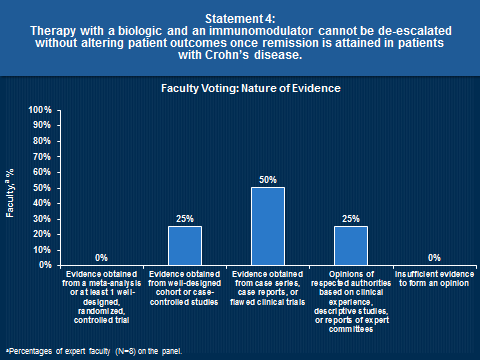
Data Review and Faculty Summary
Methods
A literature search was conducted on April 22, 2014, to identify studies that evaluated the use of combination therapy in CD and subsequent withdrawal of either the IMM or the anti-TNF agent. An online search of clinical English language publications listed in the MEDLINE database(PubMed 1997 to April 2014, US National Library of Medicine [NLM], National Center for Biotechnology Information [NCBI] ) was conducted. Studies were identified using the medical subject headings (MeSH) “antibodies,” “monoclonal,” AND “Crohn’s disease/therapy.” A total of 2045 articles were identified. This result was combined separately (AND) with the free text terms “azathioprine” (210 articles), “6-mercaptopurine” (195 articles), and “methotrexate” (116 articles). These results were also combined with the text words: “withdrawal” (47 articles) and “de-escalation” (1 article). Ultimately, 10 articles were identified as relevant to the statement. These included randomized controlled trials, case-control studies, and cohort studies.
Evidence
Several considerations were taken into account and assumptions were made when discontinuation of therapy was evaluated: (i) patients must have undergone induction therapy and responded (over a variable length of time) to a combination of an anti-TNF agent (infliximab [IFX] or adalimumab [ADA]) and a purine antimetabolite or MTX; (ii) de-escalation included withdrawal of the anti-TNF agent and/or the IMM; and (iii) recurrence was defined by either patient-reported symptoms or objective outcomes (ie, mucosal healing). Although several of the pivotal studies of anti-TNF maintenance treatment were randomized withdrawal studies in responders, it is difficult to assess the effects in patients entering into remission as these data are not published. However, it is clear that patients responding to anti-TNF induction therapy do better if they continue on maintenance therapy rather than have their anti-TNF therapy withdrawn.
In an early study by Lemann et al,9 115 steroid-dependent CD patients received AZA or MP and were randomized to either induction therapy with IFX (0, 2, and 6 weeks) or placebo.9 The study involved patients who were purine antimetabolite naïve and patients in whom purine antimetabolite treatment failed. At week 12, 75% of the patients in the IFX plus AZA/MP group were in clinical remission (CD Activity Index [CDAI] <150) and off steroids compared with 38% in the purine antimetabolite alone group (P<0.001). At week 52, 40% of the patients in the IFX plus AZA/MP group remained in steroid-free remission compared with 22% in the purine antimetabolite monotherapy arm (P=0.04). Patients who were previously naïve to purine antimetabolites did numerically better at week 52 with IFX treatment, but the success rate did not reach statistical significance (52% vs 32%; P=0.14). It appeared from this study that “bridging” steroid-dependent patients to a purine antimetabolite may not be a successful strategy and that withdrawing IFX after induction therapy led to progressive decrease in steroid-free remission rates.
Van Assche and colleagues performed a 104-week, multicenter, prospective, randomized open-label superiority trial evaluating whether the IMM (AZA/MP or MTX) could be withdrawn in patients in remission for at least 6 months after starting combination therapy with IFX.10 Patients (N=80) were randomized to either continue or discontinue their concomitant IMM. All patients continued their IFX therapy. The primary endpoint of the study was to evaluate the proportion of patients who required a decrease in IFX dosing interval or discontinued IFX. Secondary endpoints included IFX trough levels, change in C-reactive protein (CRP) over time, and mucosal healing. There were no differences in the predefined clinical outcomes of needing adjustment to IFX dosing or stopping IFX. However, patients who discontinued their concomitant immunotherapy had progressively higher CRP levels and progressively lower serum IFX trough levels. There was an inverse correlation between rising CRP and decreasing trough levels. The investigators did not observe an association between trough levels and the development of anti-IFX antibodies with episodic IFX retreatment, but the presence of antibodies may have been missed by high IFX serum levels interfering with the detection assay.10 Although not discussed during the faculty meeting, several reports have indicated that IFX treatment is associated with an immunogenic response, which is reduced by combining the anti-TNF therapy with IMM therapy.11, 12
The diSconTinuation in CrOhn's disease patients in stable Remission on combined therapy with Immunosuppressors (STORI) trial evaluated the effects of discontinuing IFX in patients who were stable on a combination of IFX and an antimetabolite.13 This was a prospective study of 115 patients with CD who were treated for at least 1 year with scheduled IFX and an antimetabolite (AZA, MP, or MTX) and had been in corticosteroid-free remission for at least 6 months. IFX was discontinued, and patients were followed for at least 1 year. After a median follow-up period of 28 months, 52 of the 115 patients experienced a relapse; the 1-year relapse rate was 43.9% (±5.0%). Based on multivariable analysis, risk factors for relapse included male sex, no previous surgical resection, leukocyte count >6.0 × 10⁹/L, hemoglobin ≤145 g/L, high sensitivity C-reactive protein (hsCRP) ≥5.0 mg/L, and fecal calprotectin ≥300 µg/g. Patients with no more than 2 of these risk factors (approximately 29% of the study population) had a 15% risk of relapse within 1 year. However a relapse was defined as a CD Activity Index (CDAI) score of >250 or between 150 and 250 points with a 70-point increase from baseline for >2 consecutive weeks, which may have underestimated the true magnitude of the relapse rate, as active disease is generally defined at a lower CDAI score threshold (eg, >200). As a result, 11 patients identified by the investigators as being in relapse were not included in the analysis as they did not fulfill the predefined CDAI-based study definition of relapse.13,14 The median time to relapse was within the first 17 months of discontinuation. Retreatment with IFX was effective and well tolerated in 88% of patients who experienced a relapse.13
Several prospective observational studies have investigated the effects of withdrawal of AZA or anti-TNF therapy in patients receiving combination therapy. Oussalah et al15 investigated the effects of AZA withdrawal on patients with CD in remission and receiving combination AZA and IFX therapy at a single referral center. Between June 2007 and January 2009, 88 patients with luminal CD on combination therapy were assessed. Of these, 48 patients who were considered to be in clinical remission (CDAI <150) stopped AZA after receiving IFX in combination with AZA for at least 6 months. At last follow-up, 35 of the 48 (73%) patients did not have IFX failure (defined as disease flare requiring IFX dose adjustment or switch, IFX discontinuation, or CD-related surgery). The survival probabilities were 85% (±5%) at 12 months and 41% (±18%) at both 24 and 32 months. Three predictors of IFX failure were identified using the Cox proportional-hazards regression: IFX/AZA exposure duration of ≤811 days (hazard ratio [HR], 7.46; P=0.01), CRP >5 mg/L (HR, 4.79; P=0.008), and platelet count >298 x 109/L (HR, 4.75; P=0.02). The authors concluded that in patients on IFX combination therapy, AZA withdrawal is associated with a high risk of relapse, especially in patients with treatment duration of <27 months and/or in those with biologic inflammation.15
An observational study from Hungary performed by Molnar and colleagues8 attempted to identify predictors of relapse in patients stopping biologic therapy. The study included 121 CD patients who had achieved clinical remission after at least a year of biological therapy (IFX: n=87; ADA: n=34) and subsequently stopped. Relapse and indication for restarting biologics was defined as an increase of >100 points in CDAI together with a CDAI of >150 points. The study findings showed that biologic therapy was restarted within a year of treatment cessation in 45% of patients who had achieved remission, the majority of whom (84%) had continued purine antimetabolite therapy throughout the study. Logistic regression analysis demonstrated that the need to restart biologic therapy was associated with previous biologic therapy (P=0.011) and dose intensification during the 1-year course of biologic therapy (P=0.024).
Several retrospective/prospective cohort studies have shown conflicting results of continuing or concomitant use of IMM with anti-TNF therapy. Moss et al3 reported the results in a retrospective cohort of 123 patients followed for 5 years after the initiation of IFX for active CD. Clinical remission rates were 73% (n=82/113) at 1 year, 65% (n=65/100) at 2 years, and 58% (n=21/36) at 5 years in patients receiving IFX maintenance. Remission rates were significantly improved in patients receiving maintenance IFX and concomitant IMM compared with maintenance IFX alone at 1 year (86% vs 68%; P=0.03) but not at 2 years (80% vs 72%; P=0.4). Logistic regression analysis revealed that concomitant IMM use in patients on maintenance IFX did not significantly improve the odds ratio (OR) for achieving remission at 2 years [OR, 1.1; 95% CI, 0.9–1.2; P=0.9]. The risk of surgery was significantly reduced in patients receiving IMM at the start of maintenance IFX (OR, 0.3; 95% CI, 0.1–0.7; P=0.01), but not in those who continued maintenance IFX and concomitant IMM therapy for 2 years (OR, 0.4; 95% CI, 0.1–1.5; P=0.1). The authors concluded that the combination of maintenance IFX and an IMM modestly improved clinical outcomes (statistically significant at 1 year; P=0.03) beyond maintenance IFX alone in this cohort, though combination therapy was not recommended in patients receiving maintenance infliximab due to a small risk of infection and malignancy.
In contrast, a prospective study from a French cohort demonstrated the value of continuing IMM in patients receiving IFX.16 Patients with inflammatory bowel disease (IBD) (UC: n=23; CD: n=98) were treated with IFX for at least 12 months and received at least 6 months of IMM co-treatment (AZA or MTX) prior to the study. For each patient, the IFX treatment duration was divided into semesters (defined as a 6-month period of IFX treatment) and independently analyzed for IBD activity. The frequency of IBD flares, perianal complications, and switch to ADA was reduced in semesters with concomitant IMM use than in those without IMM use (IBD flares: 19.3% vs 32.0%; P=0.003; perianal complications: 4.1% vs 11.8%, P=0.03; switch to ADA: 1.1% vs 5.3%; P=0.006). Semesters with IMM use were linked to lower maximal CRP levels and reduced IFX dose/kg escalation. In a multivariate analysis, co-treatment with IMMs was associated with reduced risk of IBD flare (OR, 0.52; 95% CI, 0.35–0.79), though flares were less frequent in semesters with AZA treatment compared with MTX.
A study from Oxford, United Kingdom, and Liège, Belgium, showed similar results in a cohort of 207 CD patients treated with ADA.17 Treatment periods divided into 6-month semesters were retrospectively analyzed for treatment success and efficacy of ADA monotherapy versus combination therapy with ADA and IMM for flare or treatment failure. Flare was defined as a need for ADA dose escalation, starting steroids, perianal complication, or surgery; ADA failure was defined as either withdrawal for secondary loss of response or intolerance. Univariate and multivariate analyses were used to compare semesters with and without flares. Successful induction (defined as clinical response or remission) was achieved in 171 (83%) patients, with no significant difference between ADA and IMM combination therapy or ADA monotherapy (85% vs 82%; P=0.50). Maintenance analysis was performed on 562 semesters in 181 patients. Combination therapy was not associated with fewer semesters with flare versus ADA monotherapy (34% vs 35%; P=0.96) or with ADA failure (6% vs 8%; P=0.43). Nevertheless, combination therapy in the first semester was associated with a lower risk of ADA failure (5% vs 10%; OR, 0.48; P=0.04) and combination therapy beyond 6 months was associated with fewer semesters with flares (14% vs 36%; OR, 0.31; P=0.02).
Nature of Evidence Results