Data Review and Faculty Summary
Methods
Studies that assessed early CD treatment and disease modification were identified using PubMed (US National Library of Medicine [NLM], National Center for Biotechnology Information [NCBI]). An online literature search was performed on April 27, 2014 assessing the 1997 to April 2014 MEDLINE database using the medical subject headings (MeSH) “Crohn’s disease, disease modification, anti-TNF antibodies” (6 articles); “early Crohn’s disease, anti-TNF” (44 articles); “early Crohn's disease AND top-down treatment” (43 articles); “Crohn’s disease AND early AND disease modification AND infliximab OR adalimumab OR anti-TNF” (9 articles). The search was then limited to publications in English and in humans. After further selection with exclusion of reviews, editorials, opinion papers, case reports, or overlap, 10 articles remained that were relevant to the above statement.
Evidence
Rubin and colleagues examined a health insurance database and selected patients diagnosed with CD who were enrolled in the same plan for ≥6 months prior to diagnosis, had anti-tumor necrosis factor-α (anti-TNF) claim(s), and whose initial anti-TNF claim was ≥12 months prior to analysis.5 Three populations were compared: 1) Step-up (n=1398), patients who received mesalamine and/or corticosteroids prior to anti-TNF treatment; 2) Immunosuppression (IS)-to-TNF inhibitor (n=1031), patients who received immunosuppressants prior to anti-TNF treatment; and 3) Early-TNF (n=1321), patients who received biologic treatment within 30 days following their first prescription for CD treatment. Follow-up data were assessed up to 24 months after anti-TNF therapy initiation. At months 12, 18, and 24 of follow-up, the Early-TNF group had a lower relative risk (RR) of concomitant corticosteroid use compared with the Step-up (RR, 1.79; 95% confidence interval [CI], 1.47–2.18; P<0.05) or IS-to-TNF groups (RR, 1.42; 95% CI, 1.14–1.76; P<0.05). The Early-TNF group also had a lower rate of CD-related surgeries (9%) compared with the IS-to-TNF (14%) and the Step-up (12%) groups at 24 months.5
Lee and colleagues reported on a pediatric CD cohort of 28 patients, mean age of 13 years, who were categorized as treated with anti-TNF therapy early-on (top-down) or refractory to conventional drug treatment (step-up).6 Clinical relapse, defined as pediatric CDAI score >10, was assessed at 1, 2, and 3 years of follow-up.6 The relapse rate was significantly lower in patients who received top-down treatment than in patients who had first failed conventional treatments at 2 years of follow-up (50% vs 90%, respectively; P<0.05). At 1 and 3 years, a similar trend was observed, though significance was not reached, possibly due to small sample size.
A larger pediatric study (median age 12 years) compared early intervention (≤3 months following diagnosis) with immunomodulators (IMMs) and anti-TNF treatment in the Risk Stratification and Identification of Immunogenetic and Microbial Markers of Rapid Disease Progression in Children with Crohn’s Disease (RISK) study population (n=552 in North America).7 Patients treated with early anti-TNF therapy, early IMMs, or no early immunotherapy, were matched into 68 groups of 3 by baseline disease characteristics and were evaluated for steroid-free and surgery-free remission and growth. Early anti-TNF monotherapy resulted in better overall clinical and growth outcomes at 1 year. This study was assessed after the live appraisal; therefore, the results were not presented to or voted on by the faculty.
Abraham et al looked at the other end of the age spectrum (mean age 61 years) in a retrospective, observational cohort of 20,474 United States veterans with inflammatory bowel disease (IBD) (8042 with CD), of whom 1.3% received IMM monotherapy, 0.17% received anti-TNF monotherapy, and 1.5% received IMM and anti-TNF combination treatment.8 The objective was to assess 1-year hospitalization and IBD-related surgery rates after initiation of treatment. Counts of hospitalizations or surgeries were modelled by Poisson or logistic regression, respectively, with the drug therapy duration variables as predictors. In these models, the time to a 50% relative reduction in hospitalizations was reached after 7.7 months with combination treatment (P=0.02), 8 months with anti-TNF monotherapy (P<0.0001), and 9.2 months with IMMs alone (P<0.0001). A 50% relative reduction in IBD-related surgeries was observed after 5 months on combination therapy and 7 months on monotherapy. Further, after 12 months on IMMs alone, a 36% relative reduction in surgery compared with no drug exposure was reported (all nonsignificant). However, at 9 months into treatment, surgery was reduced over 90% for both monotherapy and combination therapy with anti-TNF treatment, and hospitalizations were reduced by 67% on monotherapy and 86% on combination therapy.
Eshuis and colleagues in Amsterdam retrospectively studied a cohort of 469 patients consecutively started on IFX between 1993 and 2010, with a median follow-up of 4.5 years.9 Patients who received maintenance IFX treatment had a 31% reduction in abdominal surgery rates from 8.76 interventions per 100 patient-years before starting treatment to 6.06 interventions after treatment initiation (P=0.018).
Although not evaluated during the live Clinical Appraisal, the EXTEND trial10 was the first interventional trial with an anti-TNF agent that used endoscopy as a primary endpoint. In this study, ADA treatment was evaluated for inducing and maintaining mucosal healing, defined as, “absence of mucosal ulcerations at week 12.” In the 135 patients with active ileocolonic CD who were investigated, mucosal healing was observed in more patients on maintenance treatment with ADA for 52 weeks than in patients who only received induction treatment (24% vs 0%; P<0.001). A post-hoc analysis of data from EXTEND revealed a trend toward higher rates of deep remission, an exploratory definition that encompassed absence of mucosal ulcerations along with a CDAI score <150, in patients with short disease duration (<5 years).2 Compared with patients without deep remission at week 12 (non-remitters), patients who achieved deep remission at week 12 required fewer ADA dose increases (P<0.02), hospitalizations (0 remitters versus 9 [17%] non-remitters), or CD-related surgeries (0 remitters versus 5 [9%] non-remitters) over the maintenance period (52 weeks). Patients with deep remission at week 12 also had better quality of life measured by the IBD Questionnaire (IBDQ; P<0.05) and Short Form 36 Health Survey Physical Component Summary (SF-36 PCS; P<0.05) and lower total activity impairment (TAI) score (P<0.05) at week 52.2
In 2008, data were published from a top-down versus step-up trial in patients with newly diagnosed CD.1 A subset of the 133 patients taking part in this trial underwent endoscopy after 2 years of therapy and were followed for an additional 2 years.11 Patients who had no ulcerations at year 2 had significantly better outcomes at year 4 in terms of clinical relapse (P=0.036) and reduced need for further IFX or corticosteroid treatments (P=0.032).
Since then, several other reports have indicated that mucosal healing is associated with favorable outcomes.12 A post hoc analysis of the A Crohn’s Disease Clinical Trial Evaluating Infliximab in a New Long-term Treatment Regimen (ACCENT-1) maintenance trial, in which episodic IFX treatment was compared with scheduled infusions every 8 weeks, also reported that mucosal healing at both weeks 10 and 54 was associated with a reduction in CD-related hospitalizations to 0 in the subset of patients who underwent serial endoscopies.12 CD-related hospitalizations and surgeries were also reduced during maintenance treatment with ADA in the phase 3 registration trial, Crohn’s Trial of the Fully Human Antibody Adalimumab for Remission Maintenance (CHARM).13
The Randomized Evaluation of an Algorithm for Crohn’s Treatment (REACT) study investigated the effect of biologic treatment on the natural history of CD via two different therapeutic algorithms.14, 15 REACT was a cluster randomization trial in which 39 IBD practices were randomized to either conventional management (CM) or an accelerated step-up approach, early combined immunosuppression (ECI), in which patients were reassessed for steroid-free remission every 12 weeks. If steroid-free remission was not attained, treatment was escalated from steroids to the addition of combination treatment with adalimumab (ADA) and AZA or methotrexate (MTX), later to a weekly dose of ADA and AZA and MTX, then to a switch in the IMM and finally to an alternative anti-TNF treatment with continued immunosuppression. For cases in which steroid-free remission was still not attained, resection was considered. Evidently, the use of anti-TNF agents and IMMs was significantly greater in the ECI group (P<0.001 at both 12 months and 24 months). Clinical outcome, as measured with the Harvey-Bradshaw index, was not different during the trial between the two groups. However, when hospitalizations, surgery, and serious disease-related complications were assessed, a significantly better and clinically relevant outcome was observed in the ECI group compared with the CM group in the second year of treatment (P<0.001).
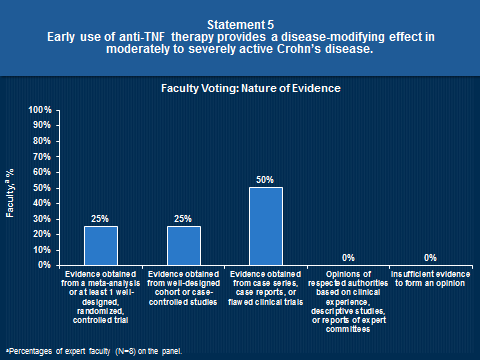
Nature of Evidence Results