Data Review and Faculty Summary
Methods
An online literature search for English language publications was conducted on March 26, 2014 to identify clinical studies that evaluated the efficacy of azathioprine (AZA) or 6-mercaptopurine (MP) for ulcerative colitis (UC) or CD treatment using the MEDLINE (PubMed up to March 2014, US National Library of Medicine [NLM], National Center for Biotechnology Information [NCBI]). Parallel-group randomized controlled trials (RCTs) and cohort studies were included. Studies were identified using the search strings “azathioprine OR 6-mercaptopurine AND inflammatory bowel diseases OR Crohn’s disease OR colitis, ulcerative OR fistula,” as medical subject headings (MeSH). A total of 1798 studies were identified. Other MeSH terms searched and combined with the previous were: “treatment outcomes” (329 studies), “clinical trial” (209 articles), “surgical procedures” (262 articles), “fistula” (54 articles), and “hospitalization” (16 articles). Ultimately, 13 articles were identified as relevant to the statement.
Evidence
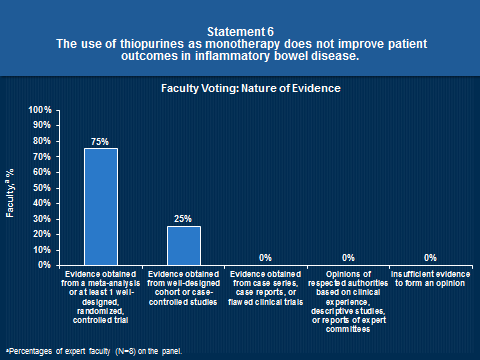
Several meta-analyses have investigated the efficacy of thiopurines for induction and maintenance of remission in UC or CD. A Cochrane systematic review determined the efficacy and safety of AZA and MP for induction of remission in active CD, based on 13 RCTs including 1211 patients.6 This meta-analysis did not find a difference between AZA or MP and placebo in clinical remission and clinical improvement rates, respectively. However there was a statistically significant difference between AZA and placebo in steroid sparing, defined as a prednisone dose <10 mg/day while maintaining remission (relative risk [RR], 1.34, 95% confidence interval [CI], 1.02–1.77).
Khan et al conducted a meta-analysis on the efficacy of thiopurines for maintenance of remission in CD.7 The analysis, which included two trials with a total of 198 patients, demonstrated that AZA does not have a significant benefit over placebo in treating quiescent CD. Three additional AZA withdrawal trials in 163 patients indicated that continuing medication prevented relapse (RR, 0.39; CI, 0.21–0.74). This apparent discrepancy may be related to the fact that withdrawal trials inherently favor treatment responders and patients who tolerate the drug; this bias is particularly relevant to AZA studies, as approximately 20% of patients discontinue AZA treatment due to adverse events.4,5 The results in UC are analogous to those in CD. Two RCTs that evaluated AZA for induction of remission in 130 patients with active UC demonstrated a non-significant trend favoring AZA over placebo.7 Three RCTs that evaluated AZA for prevention of relapse in 127 patients with quiescent UC demonstrated association with a statistically significant benefit compared with placebo (RR, 0.60; 95% CI, 0.37–0.95; P=0.03).7
A fundamental goal of CD therapy is to alter its progressive course and for this reason, early therapy is becoming more prevalent. In a small, randomized, placebo-controlled trial conducted in 55 steroid-treated children with newly diagnosed CD who had achieved remission, MP treatment start within 8 weeks of diagnosis led to significantly reduced relapses (P=0.007), duration of steroid use (P<0.001), and cumulative steroid dose received (P<0.01) over 18 months of follow-up compared with placebo.8 The results of this trial led to wider acceptance of early thiopurine use in pediatric patients.9 Two trials assessing the efficacy of early treatment with AZA in adults did not show a benefit similar to that seen with pediatric patients.4, 5 One of these trials4 had a design almost identical to the pediatric study:8 adult patients with CD were randomized to receive AZA or placebo within 8 weeks of diagnosis and were subsequently followed for 76 weeks.4 At the end of the follow-up period, the proportion of patients with sustained steroid-free remission, which was the primary endpoint of the study, was similar in the active and placebo arms. The rate of relapse and steroid requirements were also similar in the two groups. Another early AZA treatment study in an adult CD patient population compared 2 treatment strategies: AZA treatment within 6 months of diagnosis versus a conventional treatment strategy.5 The primary endpoint of this study was the proportion of trimesters spent in corticosteroid-free and anti-TNF/AZA remission during 3 years of follow-up. Differences between early and conventional AZA use for this endpoint were not detected, however a higher cumulative proportion of patients in the AZA group than in the conventional management group remained free of perianal surgery (96% vs 82% at month 36; P=0.036).
Evidence on the efficacy of AZA for treatment of perianal fistulizing disease is scarce; there are no prospective RCTs evaluating thiopurine treatment with fistula formation or fistula worsening as the primary endpoint. Despite this, a meta-analysis of RCTs was performed assessing the efficacy of AZA or MP in a subgroup of patients with CD who had perianal fistulizing disease at baseline.10 Fistula healing was a secondary endpoint in this meta-analysis, whereas the primary analysis was clinical remission. Pooled data from RCTs showed that fistula healing was observed in 54% of patients treated with either AZA or MP and 21% of placebo patients (odds ratio [OR], 4.44; 95% CI, 1.5–13.2). A subsequent open-label study that compared the efficacy of antibiotics (ciprofloxacin and metronidazole) with the combination of antibiotics with AZA11 observed a response, defined as a ≥50% reduction from baseline in the number of draining fistulas in 48% of patients treated with the combination therapy (n=29) compared with 15% of those treated with antibiotics alone (n=20; P=0.03).
It is essential to evaluate the disease-modifying effects of treatments. The endpoints that should be used to evaluate long-term outcomes in CD are not well established, but surgery has been commonly used, probably because it is clinically meaningful and easy to measure. A population-based cohort study of 5640 incident cases of CD diagnosed between 1989–1993, 1994–1999, and 2000–2005 in the UK showed a 5-year cumulative probability of thiopurine use of 12%, 18%, and 25% (P<0.0001), respectively.12 The probability of first intestinal resection in each respective group was 15%, 12%, and 9% (P<0.001). Patients treated with thiopurines for at least 6 months had a 44% reduced risk of surgery (hazard ratio [HR], 0.56; 95% CI, 0.37–0.85) and those treated for at least 12 months had a 69% reduction (HR, 0.31; 95% CI, 0.22–0.44). A study from Denmark of 48,967 patients diagnosed with IBD between 1979–2011 observed progressively increased use of thiopurines and anti-TNF agents and reduced surgery rates over time.13 However when comparing the use of AZA or oral corticosteroids with placebo, no significant surgery-sparing effect was found. This study also failed to identify a surgery-sparing effect of AZA in UC patients.
An observational study of a referral center cohort including 296 incident cases with CD showed that AZA treatment for less than 45 days was associated with a two-fold increased risk of major abdominal surgery after adjusting for propensity scores of 2.00 (95% CI: 1.20–3.34).14 Other independent predictors of surgery requirement identified in this study were the presence of strictures or penetrating lesions at diagnosis and treatment with anti-TNF agents for less than 16 months. The suggestion that the use of thiopurines reduces the need for surgical resection in CD is supported by the results of a meta-analysis of 17 retrospective observational studies with a total of 21,632 participants.15 This study reported a 40% reduced risk of surgical resection in patients being treated with thiopurines, although the studies analyzed were evaluated as being of moderate quality. The combined pooled HR of first intestinal resection with thiopurine treatment from 10 studies involving 12,586 patients was 0.59 (95% CI, 0.48–0.73).
Operative resection of the diseased bowel does not cure CD and postoperative recurrence remains a problem in patients with CD. A meta-analysis of 4 controlled trials including 433 patients with CD compared thiopurine therapy with control arms (placebo with or without antibiotic induction therapy or mesalamine) and showed that thiopurine treatment was significantly more effective than the control treatments at preventing clinical recurrence, with a mean reduction of 8% at 1 year (P=0.021) and 13% at 2 years (P=0.018).16
Nature of Evidence Results