Data Review and Faculty Summary
Methods
An online literature search was performed on March 20, 2014 to identify studies relating the use of anti-TNF agents in combination with immunomodulators (IMMs) with regard to serious infections and malignancies in IBD patients. Publications listed in PubMed from 1997 to 2014 (US National Library of Medicine [NLM], National Center for Biotechnology Information [NCBI]), the Cochrane Library (John Wiley & Sons, Hoboken, NJ), and Web of Science (Thomson Reuters, Philadelphia, PA) were identified using the search strings “inflammatory bowel disease AND anti-tumor necrosis factor OR immunomodulators.” The search was limited to English language studies in humans. Book chapters, case reports, conference abstracts, editorials, letters, and comments were excluded. The result of this search was then combined (AND) individually with “clinical trial” (209 articles), “surgery” (262 articles), “fistula” (54 articles), and “hospitalization” (16 articles). A total of 11 articles were finally chosen as relevant to the statement.
Evidence
Infections
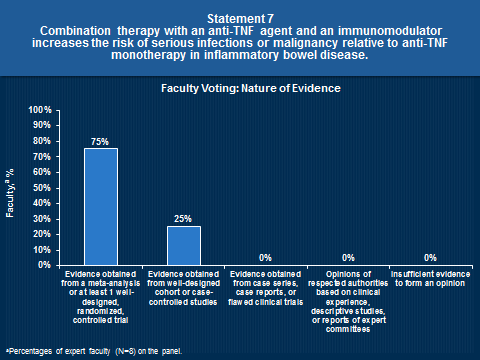
A report from a case-control study detailed the increased risk of opportunistic infections associated with immunosuppressive therapy when used in combination with other IBD therapies.3 However since disease activity was not accounted for in this analysis, the observed correlation may be between disease severity and opportunistic infections rather than treatment and opportunistic infections. A large cohort study of IBD patients in Belgium showed that concomitant treatment with steroids was the only independent risk factor for infections in patients treated with IFX (odds ratio [OR], 2.69; 95% confidence interval [CI], 1.18–6.12; P=0.018) in 734 IFX-treated and 666 control patients.4 In a meta-analysis of randomized controlled trials (RCTs) with individual patient-level data, continued IMM use did not alter the safety of adalimumab (ADA)- or certolizumab pegol-associated incidence of serious adverse events such as serious infections, malignancy, or death.5,6 This was consistent with previous reports.7,8
However Marehbian et al9 found that not only do patients with Crohn’s disease (CD) have a higher prevalence of morbidities than the general population, but that treatment of CD with steroids, immunosuppressants, or anti-TNF agents, either alone or in combination, is associated with an increased risk of infections, demyelinating disorders, and cervical dysplasia. A 2013 report10 from data collected from the Food and Drug Administration Adverse Event Reporting System (FAERS) recounted that monotherapy with either an anti-TNF agent or an IMM increased the baseline odds of acquiring a serious infection, defined as one resulting in hospitalization and/or death, compared with 5-aminosalicylates and sulfasalazine treatment (P=0.046 and P=0.009 for anti-TNF and IMM therapy, respectively). However combination treatment with these drugs does not further increase the risk of serious infections relative to monotherapy.10
Malignancy
RCTs would be the optimal method by which to compare the risk of malignancy associated with combination therapy with an anti-TNF agent and an IMM relative to anti-TNF monotherapy for IBD treatment. However because the available clinical trials are underpowered and have short follow-up duration, they are inadequate for estimating the true treatment-associated malignancy risk. Only large cohorts of patients, registries, and pooled analyses of RCTs can be used to accurately estimate the risk of treatment-associated malignancy, despite the lack of information on disease activity and severity that these studies provide.
The IMM that is used in combination with anti-TNF therapy dramatically influences the risk of infections and malignancy associated with therapy. Although not presented at the live meeting, the Cancers Et Surrisque Associé aux Maladies inflammatoires intestinales En France (CESAME) cohort study demonstrated that thiopurine monotherapy is associated with an increased risk of lymphoma and non-melanoma skin cancer (NMSC), but melanoma risk was not investigated.11,12 Data from studies on adult rheumatoid arthritis patients show that methotrexate (MTX) treatment may be associated with an increased risk of malignancy.2 As MTX monotherapy is used in very few patients with IBD, whether MTX alone or in combination with anti-TNF therapy is associated with an increased risk of malignancy in IBD has yet to be determined.
A recent study,1 which was not presented at the live meeting, demonstrated that anti-TNF monotherapy does not increase the risk of lymphoma in IBD patients. This may not be true of combination therapy, as suggested by a 2009 meta-analysis combining data from RCTs, cohort studies, and case series that examined the rate of non-Hodgkin's lymphoma (NHL) in CD patients receiving anti-TNF therapy.13 The analysis, which included 26 studies involving a total of 8905 patients, showed that the use of combination therapy with anti-TNF agents and IMMs was associated with increased risk of NHL, although the overall rate of NHL events was low. A prospective cohort study examined data from the Crohn's Therapy, Resource, Evaluation, and Assessment Tool (TREAT™) Registry to investigate long-term outcomes of treatments in community and academic settings in 6273 CD patients. An exposure-based analysis reported a trend toward greater malignancy risk (OR, 3.33) with immunosuppressant use in combination with IFX than with IFX monotherapy (OR, 1.96) relative to treatment with neither.14
In a pooled analysis of data from 1594 CD patients who participated in ADA clinical trials (CLASSIC I and II, CHARM, GAIN, EXTEND, and ADHERE, with 3050 cumulative patient-years of exposure), coadministration of any IMM (azathioprine, 6-mercaptopurine, or MTX) and ADA was associated with increased risk of NMSC and other cancers.15 However, the overall cancer risk was similar between patients exposed to ADA plus thiopurine alone or ADA plus any IMM therapy, whereas ADA monotherapy did not increase this risk. Similar figures were observed in a recent report utilizing data from the FAERS.16 The risk of T-cell NHL (hepatosplenic T-cell lymphoma was the most common reported subtype) was increased with anti-TNF therapy in combination with thiopurines (95% CI, 4.98–354.09; P<0.0001) but not with anti-TNF treatment alone (95% CI, 0.13–10.61; P=1.00).
IBD treatment with anti-TNF monotherapy increases the risk of skin cancer, especially melanoma, although data are conflicting regarding the relationship between the risk of NMSC and anti-TNF therapy.17,18 McKenna et al,18 Long et al,17 and Osterman et al15 each reported studies suggesting that combination therapy is associated with an increased risk of skin cancer; only the Osterman study was presented at the live meeting. In a sub-analysis of a nested-case control study by Long et al,17 combined use of thiopurines and biologics for ≥1 year was associated with the greatest increased NMSC risk relative to thiopurine monotherapy and anti-TNF monotherapy compared with no use of these medications. Analysis of the FAERS data published after the live meeting showed that anti-TNF monotherapy and combination therapy with thiopurines increased the risk of NMSC and melanoma.18
Nature of Evidence Results