Data Review and Faculty Summary
Methods
An online literature search was conducted on May 1, 2014 to identify studies that evaluated UC treatment with biologic therapies. The search was limited to English language publications in humans in the MEDLINE database (PubMed 1997 to May 2014, US National Library of Medicine [NLM], National Center for Biotechnology Information [NCBI]). Studies were identified using the search terms “antibodies,” “monoclonal,” and “colitis, ulcerative," as medical subject headings (MeSH). A total of 698 articles were identified. The free text terms, “integrins” (16 articles), “colectomy” (160 articles), “infections” (53 articles), “malignancy” (47 articles), “mortality” (30 articles) were also searched. These were combined (AND) with the original 698 articles identified. Separate MeSH headings, “remission induction” (95 articles) and “treatment outcome” (229 articles) were also added. Randomized controlled trials (RCTs), open-label extensions, and pooled safety data of biologic therapies were included. Pivotal anti-TNF studies that included patients previously exposed to biologic therapy (such as the Ulcerative Colitis Long-term Remission and Maintenance with Adalimumab 2 [ULTRA 2] study9) were excluded in order to analyze first-line anti-TNF agent efficacy. Since the focus of this statement is whether targeting integrins may be an acceptable first-line biologic alternative to TNF, comparative effectiveness studies by network meta-analysis were also excluded. Ultimately, 12 articles were identified as relevant to the statement.
Evidence
Most of the pivotal efficacy studies have largely similar definitions of clinical response, clinical remission, and mucosal healing based on Mayo score and Mayo endoscopic subscore, with key differences in study design and patient populations. The first large (N=364) RCT of anti-TNF therapy in moderately to severely active UC was the first Active Ulcerative Colitis Trial (ACT 1) with IFX.1 In this trial 69.4% of patients receiving 5 mg/kg IFX at 0, 2, and 6 weeks demonstrated clinical response at week 8 compared with placebo response of 37.2% (P<0.001) (Table 1).1 In the similar ACT 2 study, 64.5% of patients treated with 5 mg/kg IFX demonstrated clinical response compared with placebo response (29.3%; P<0.001) at week 8 (Table 1).1 Subsequent studies of ADA (ULTRA 1)10 and golimumab (Program of Ulcerative Colitis Research Studies Utilizing an Investigational Treatment – Subcutaneous [PURSUIT-SC]) demonstrated that response rates were lower at week 8 for ADA (18.5% achieved clinical remission vs 9.2% placebo; P=0.031) and week 6 for golimumab (51% achieved clinical response vs 30.3% placebo; P<0.0001), respectively (Table 1).4, 10 Similar to ACT 1 and ACT 2, the ULTRA 1 and PURSUIT-SC studies included exclusively biologic-naïve patients. The Phase 3, Randomized, Placebo-Controlled, Blinded, Multicenter Study of the Induction and Maintenance of Clinical Response and Remission by Vedolizumab (MLN0002) in Patients with Moderate to Severe Ulcerative Colitis (GEMINI 1) study with vedolizumab showed a clinical response in 47.1% of vedolizumab- compared with 25.5% of placebo-treated patients at week 6 induction (Table 1).8 Approximately half the GEMINI 1 patients were anti-TNF naïve, but evidence for first-line treatment must be extrapolated from the total population, as there have been no studies of vedolizumab in exclusively anti-TNF naïve patients.
| Study | TNF-naïve patients (%) | Week | Clinical response | Clinical remission | Mucosal healing | |||
|---|---|---|---|---|---|---|---|---|
| Active drug (%) | Placebo (%) | Active drug (%) | Placebo (%) | Active drug (%) | Placebo (%) | |||
| IFX: ACT 1a | 100 | 8 | 69.4 | 37.2 | 38.8 | 14.9 | 62.0 | 33.9 |
| IFX: ACT 2a | 100 | 8 | 64.5 | 29.3 | 33.9 | 5.7 | 60.3 | 30.9 |
| ADA ULTRA 1b | 100 | 8 | 54.6* | 44.6* | 18.5 | 9.2 | 46.9* | 41.5* |
| Golimumab: PURSUIT-SCc | 100 | 6 | 51.0 | 30.3 | 17.8 | 6.4 | 42.3 | 28.7 |
| Vedolizumab: GEMINI 1d | 52 | 6 | 47.1 | 25.5 | 16.9 | 5.4 | 40.9 | 24.8 |
| aPatients received placebo or IFX at weeks 0, 2, and 6. bPatients received placebo or ADA at weeks 0, 2, 4 and 6. cPatients received placebo or IFX at weeks 0 and 2. dPatients received placebo or vedolizumab at weeks 0 and 2. * results did not achieve statistical significance. |
||||||||
Trials investigating maintenance of clinical remission have yielded positive results using both anti-TNF and anti-integrin monoclonal antibodies for treatment of patients with moderately to severely active UC. In the ACT studies, early mucosal healing was associated with favorable long-term clinical outcomes including reduced colectomy and improved symptomatic remission at 1 year.11 Patients in the ACT 1 and ACT 2 pivotal maintenance therapy studies were treated continuously after initial randomization at induction,1 whereas PURSUIT-SC4 and GEMINI 18 induction responders were re-randomized to receive active drug or placebo for maintenance treatment.12 In the ACT 1 study at 54 weeks, 34.7% of IFX-treated patients achieved clinical remission compared with 16.5% of placebo patients (Table 2).1 In the PURSUIT-SC study, 27.8% of golimumab-treated patients achieved clinical remission at 54 weeks compared with 15.6% of placebo (Table 2).12 In GEMINI 1, vedolizumab treatment every 8 weeks during maintenance therapy was associated with a clinical remission rate of 41.8% at 1 year compared with 15.9% with placebo (Table 2).8
| Study | Week | Clinical response | Clinical remission | Mucosal healing | |||
|---|---|---|---|---|---|---|---|
| Active drug (%) | Placebo (%) | Active drug (%) | Placebo (%) | Active drug (%) | Placebo (%) | ||
| IFX: ACT 1a | 54 | 45.5 | 19.8 | 34.7 | 16.5 | 45.5 | 18.2 |
| Golimumab: PURSUIT-SCb | 54 | 49.7 | 31.2 | 27.8 | 15.6 | 42.4 | 26.6 |
| Vedolizumab: GEMINI 1c | 52 | 56.6 | 23.8 | 41.8 | 15.9 | 51.6 | 19.8 |
| aPatients received placebo or IFX every 8 weeks through week 46. bPatients received placebo or golimumab every 4 weeks through week 52. cPatients received placebo or vedolizumab every 8 or 4 weeks through week 52. |
|||||||
Long-term, open-label extension studies (≤3 additional years) with IFX13 demonstrated that the majority of patients in remission at the end of the randomized controlled phase maintained long-term remission, and this has generally been the experience with other biologic agents also.14 In the ACT 1 and ACT 2 studies, the proportion of IFX-treated patients who had a colectomy within 1 year was 10% compared with 17% of placebo-treated patients (P=0.02).15 IFX treatment was also associated with fewer hospitalizations per 100 patient-years of treatment compared with placebo (20 vs 40; P=0.003).
The benefit–risk profiles of biologic therapies such as anti-TNF treatments and vedolizumab are distinct from steroids and immunomodulators, making them attractive treatment options for first-line therapy. Steroid use is generally limited to induction therapy because of prohibitive long-term safety risks, which include risk of hyperglycemia, cataract formation, and aseptic joint necrosis,16 while immunomodulators confer an increased risk of opportunistic infections.17 In pivotal Phase 3 studies there was no significant difference between the number of UC patients exposed to IFX and placebo who had serious infections (5.4% vs 2.4%, respectively; P=0.085).18 Other anti-TNF drugs, such as ADA in CD, have similar rates of serious infectious events (≤1.2%).19 Furthermore, anti-TNF treatment did not seem to be correlated with an increase in malignancies in UC patients.18 With vedolizumab, fewer than 2% of UC patients developed serious infections compared with approximately 3% of placebo patients.8 Similarly, 0.2% of vedolizumab-exposed UC patients developed malignancies (n=1; colon cancer) relative to 1.1% of patients receiving placebo (n=3; colon cancer, transitional cell carcinoma, and squamous cell carcinoma of the skin).8
The first integrin antagonist approved for CD was natalizumab, which is less selective than vedolizumab. Its adoption has been limited by an increased risk of developing progressive multifocal leukoencephalopathy (PML).20 In an animal model of multiple sclerosis, which demonstrates a protective effect of natalizumab, vedolizumab had no effect.21 In healthy volunteers, administration of a single dose of 450 mg vedolizumab did not lead to clinically relevant changes in the mean cerebrospinal fluid CD4+:CD8+ T-lymphocyte ratio and mean or median cell counts, indicating that vedolizumab does not impair central nervous system (CNS) immune surveillance.22 These observations suggest that the risk of developing PML will be reduced with vedolizumab,20 as the gut-specificity of the interaction between the α4β7 integrin and MAdCAM-1 may limit systemic and CNS immunosuppression.
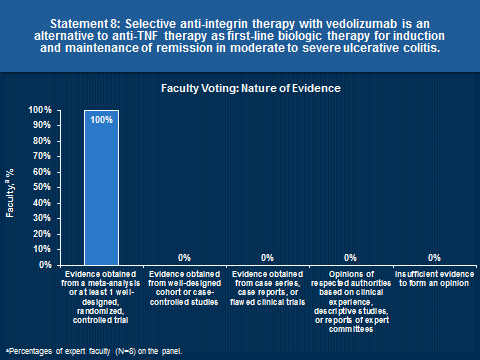
Nature of Evidence Results