
International and Faculty Survey Comparison and Faculty Discussion
Discussion
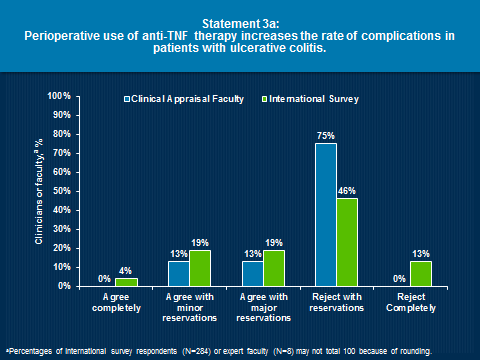
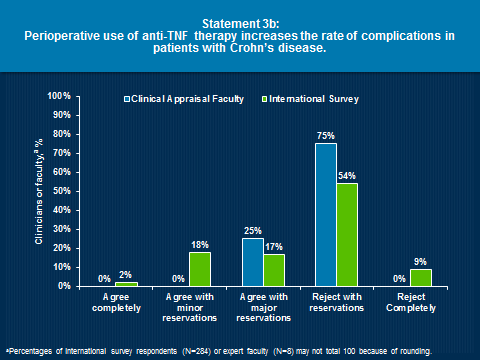
For voting purposes, Statement 3 was separated into Part 3a for UC and Part 3b for CD. This approach was used to identify whether any difference was perceived between disease states and to detect differences in the field survey. The data regarding postsurgical complications in IBD subjects receiving IFX prior to surgery are conflicting. Some studies and meta-analyses have suggested that anti-TNF agents may be associated with increased risk of infectious postoperative complications, such as anastomotic leak/abscess, sepsis, pneumonia, peritonitis, or wound infection.5, 7, 11 However these studies have been retrospective and therefore may be biased and confounding, given the inability to accurately ascertain severity and duration of illness, malnutrition, and type and duration of exposure to antibiotics and immune-suppressing medications. Interpretation of the current literature on safety of perioperative anti-TNF treatment exposure is further complicated by heterogeneity in the definitions used for infectious complications, the types of surgeries analyzed, and the definition of anti-TNF treatment exposure.5 At the time of this Clinical Appraisal, no study had assessed the relationship between perioperative anti-TNF drug levels and postoperative infectious complications in a meaningful number of patients. The most convincing evidence was judged by the Faculty to come from two population-based studies from Denmark that showed no increased risk of postoperative complications linked to the use of anti-TNF agents, both in UC and CD.14, 15 Since the Clinical Appraisal, increased preoperative serum anti-TNF drug levels have been associated with adverse postoperative outcomes. In CD patients (n=123) with serum levels ≥3 µg/mL, postoperative morbidity (P=0.03) and infectious complications (P=0.03) were higher than in patients with serum levels of <3 µg/mL; further, patients with serum levels ≥8 µg/mL had higher rates of postoperative morbidity (P=0.047) and hospital readmissions (P=0.04) than those with serum levels <3 µg/mL. Increased preoperative serum anti-TNF drug levels were not associated with adverse postoperative outcomes in UC patients (n=94).16