
International and Faculty Survey Comparison and Faculty Discussion
Discussion
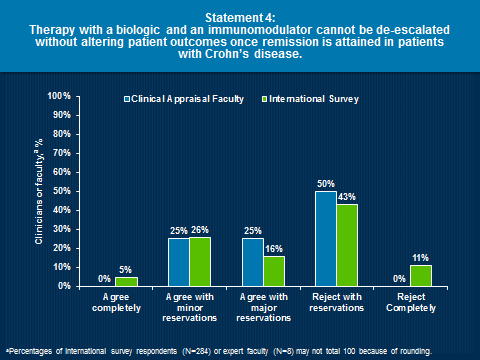
The faculty voting highlights the lack of robust evidence to guide clinical practice. With limited high-level evidence, it is not surprising that even experts interpret the available data differently. The varied interpretations of data likely account for the distributions seen in the faculty voting. Also, in the absence of high-level evidence, clinicians rely on other factors, such as expert opinion, to justify their position. Depending on the individual expert, very different opinions may be conveyed to community gastroenterologists. Thus diverse viewpoints influence some individuals to have strong opinions about the statement, as is seen in the field survey. The appropriateness of withdrawing therapy in patients who have achieved a considerable period of remission is still debated.
To date, there are no well-designed, prospective, randomized controlled trials in CD with sufficient power that measure clinically meaningful endpoints to adequately answer the question of whether therapy with a biologic and an IMM can be de-escalated without altering patient outcomes once remission is attained. Furthermore, the definition of relapse is problematic because of the disconnect between symptoms and objective parameters of disease recurrence.18 Standardized definitions of relapse used in clinical trials may not be relevant in clinical practice. Perhaps this question needs to be answered by focusing on disease relapse rather than symptomatic relapse; for example, by examining endoscopic recurrence, a monitoring strategy similar to that used in postoperative CD.
The multidisciplinary second European Panel on the Appropriateness of Crohn's Disease Treatment (EPACT-II) recommends discontinuing therapy for patients in remission and has proposed rules for withdrawing treatment.7 Even expert panels may disagree, but taken together, the data suggest that combination therapy is the preferred strategy during both the induction and maintenance phase of therapy in CD. During induction, combination treatment is superior at inducing steroid-free remission and for achieving mucosal healing.5 Combination therapy is also associated with a higher serum concentration of anti-TNF agents and reduced anti-drug antibodies in both the short and long term.10,11,12 Once in remission, withdrawal of either the IMM or the anti-TNF agent is associated with several poor outcomes that are clinically significant to both patients and physicians.13, 15 There is no rationale for discontinuing effective therapy for a chronic disease, unless the patient develops toxicity or stops responding. Although there is a minority of patients for whom the increased toxicity demands discontinuation of one or both drugs, the benefits greatly outweigh safety concerns in the majority of patients.19