
International and Faculty Survey Comparison and Faculty Discussion
Discussion
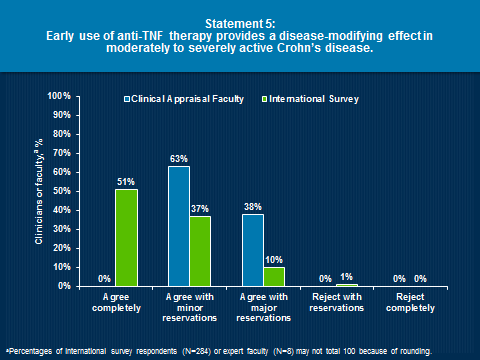
The statement under discussion was voted on by the Clinical Appraisal faculty and a number of clinicians. A higher proportion of non-expert physicians were in agreement with the statement than the proportion of experts. All experts had reservations, which appears appropriate given the lack of direct evidence from prospective trials. The results of the vote were also confounded by the fact that interpretation of the concepts, “early use” and “disease-modifying effect” may vary. No studies have investigated “disease-modifying” as a primary endpoint and it is difficult to reach consensus on a desirable definition because adverse outcomes such as surgery and hospitalizations affect the natural history of CD. A project conducted by the International Program to develop New Indexes in Crohn's disease (IPNIC) developed an instrument to quantify bowel damage (CD Digestive Damage Score or the Lémann score), but to date it has not been used in prospective trials.16 The most challenging aspect in using disease modification as a clinical endpoint lies in the duration of the trials needed, as illustrated by the REACT trial, which had a follow-up of 2 years.14
Anti-TNF treatment for CD is associated with reduced adverse outcomes, such as surgery, fistula formation, and hospitalizations.12 A possible explanation for this is increased rates of anti-TNF treatment-associated mucosal healing, as shown in the ACCENT-1 trial with IFX and the EXTEND trial with ADA.2 Mucosal healing is often defined as the absence of ulcerations, although preliminary evidence suggests that a reduction in ulcer load by approximately 50% may also be beneficial.17 Thus further investigation of varying degrees of mucosal improvement is warranted in large datasets or, preferably, prospective studies. A methodological challenge of such studies is that the duration of follow-up needed to detect significant reductions of endpoints is less straightforward than symptomatic remission; although surgeries and hospitalization were significantly reduced during the CHARM trial13 and the ACCENT-1 trial,12 a more pronounced effect is to be expected with longer follow-up, as shown in the REACT-1 trial.14
Mucosal healing is easier to attain in CD patients with a shorter disease duration than it is in those with longer disease history.18 This may be explained by changes in the pathophysiology of inflammation or fibrostenotic complications, both of which are associated with chronic disease.19, 20 Since all available treatments, including anti-TNF agents, target active inflammation, pre-existing fibrostenosis persists despite treatment and often leads to obstructive symptoms and the need for surgical intervention.21 This may also explain the fact that anti-TNF agents are more efficacious in newly or more recently diagnosed disease than in well-established disease, independent of mucosal healing. Post hoc analyses of the CHARM study stratified ADA-treated CD patients into 3 subgroups based on disease duration, including those with <2 years of CD, 2 to <5 years, and ≥5 years. Disease duration was found to be an independent predictor for higher remission rates in adalimumab-treated CD patients; at week 56, clinical remission rates were significantly greater for ADA-treated versus placebo-treated patients in all 3 disease duration groups (P=0.024; P=0.028; P<0.001).22 Interestingly, the positive effect of early intervention was not reproduced with AZA in adult or pediatric CD patients.7, 23 Consensus is growing that early disease with an unfavorable prognostic profile should be treated with anti-TNF therapy early on.1 So far, however, this prognostic profile has only been based on phenotypic characteristics such as young age, perianal disease, and initial requirement for steroid use.24 Identification of biomarkers predictive of poor prognostic profile is urgently needed.