
International and Faculty Survey Comparison and Faculty Discussion
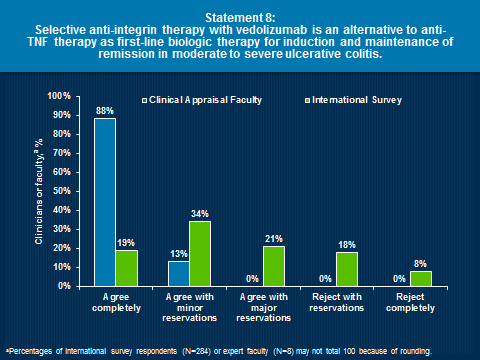
Discussion
The majority of the faculty voted in agreement with this statement, whereas the opinions expressed by the International Survey varied widely. This may have been due to the greater familiarity of the Faculty, who are mostly IBD specialists, with vedolizumab clinical trials. Data from these clinical trials generally support the idea that anti-integrin therapy with vedolizumab can be an alternative to anti-TNF therapy as first-line biologic in moderately to severely active UC.23
TNFs and integrins have each been shown to be suitable targets for UC therapy.8,24 Likewise, both anti-TNF agents and vedolizumab are effective as induction and maintenance treatment in biologic-naïve patients with moderately to severely active UC, with favorable results for remission, response, and mucosal healing.8,25 In addition, vedolizumab has not been shown to induce systemic immunosuppression and, likely as a result of this, has a favorable safety profile.8 Vedolizumab may thus be an effective alternative to anti-TNF antibodies in patients for whom conventional therapies have failed. A recent network meta-analysis demonstrated that anti-TNF antibodies and vedolizumab had comparable efficacy and safety through indirect comparison.26
Some factors to consider when deciding between vedolizumab treatment and anti-TNF therapy are specific to the patient population in question. For example, in hospitalized patients with acutely to severely active UC, IFX treatment is currently the first-line biologic therapy of choice, although this is probably because other agents have not been adequately studied in this population.27 For patients with weakened immune systems, perhaps because of a comorbidity or advanced age, a gut-specific therapy such as vedolizumab may be preferred over a systemically acting agent. Additional clinical studies and real-world data are needed to further refine practice in these and other UC patient populations.