Won - Figure 22
Servoventilation
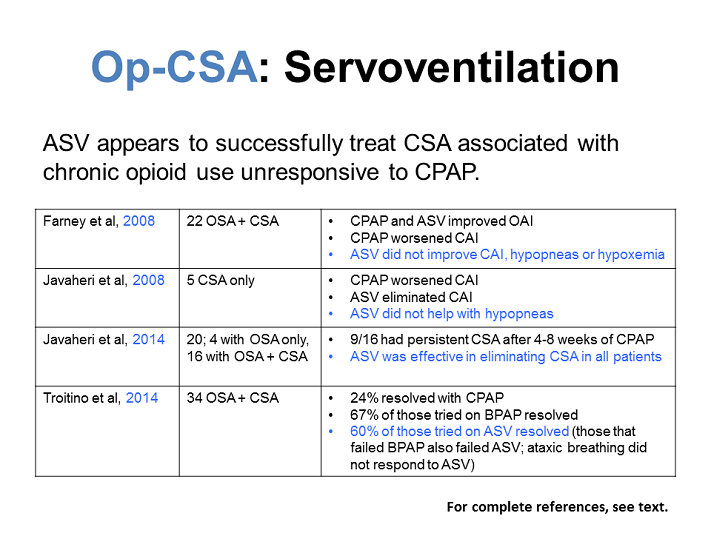
FIG. 22: The success of adaptive support ventilation (ASV) in the treatment of CSR has led to consideration of its use in patients who are on long-term opioids and who have SDB. ASV devices operate by an internal algorithm designed to treat CSA that is associated with regular cyclical breathing patterns. ASV adjusts breath-by-breath inspiratory pressure (IPAP) to prevent periodic breathing. The algorithm consists of varying pressure support in response to the patient’s baseline respiratory efforts. There is also an expiratory pressure (EPAP) feature that is administered to treat any comorbid OSA, and a backup rate for mandatory breaths if central apneas occur.
There is emerging interest in using ASV for Op-CSA, although the type of breathing in Op-CSA is often different from CSR. Although earlier studies of ASV were inconclusive,[14] more recent studies have suggested that ASV may improve Op-CSA.[15,18,19] It is not clear whether the failure of ASV initially to stabilize ventilation in these patients was related to the presence of an underlying, highly irregular rhythm.
ASV is designed to target minute ventilation driven by the patient’s own preceding efforts. Since opioids produce the complication of hypoventilation or reduced respiratory effort and respiratory depression, there is a theoretical concern that ASV may actually exacerbate chronic hypoventilation in this patient group.
References
Farney RJ, Walker JM, Boyle KM, et al. Adaptive servoventilation (ASV) in patients with sleep disordered breathing associated with chronic opioid medications for non-malignant pain. J Clin Sleep Med. 2008;4:311–319.
Javaheri S, Malik A, Smith J, Chung E. Adaptive pressure support servoventilation: a novel treatment for sleep apnea associated with use of opioids. J Clin Sleep Med. 2008;4:305–310.
Javaheri S, Harris N, Howard J, Chung E. Adaptive servoventilation for treatment of opioid-associated central sleep apnea. J Clin Sleep Med. 2014;10:637–643.
Troitino A, Labedi N, Kufel T, El-Solh AA. Positive airway pressure therapy in patients with opioid-related central sleep apnea. Sleep Breath. 2014;18:367–373.
.